Artificial Intelligence in Orthopaedics: Clinical Performance, Limitations, and Translational Readiness, A Review

It is our great pleasure to announce new article from Polish Telemedicine and e-Health Society, Medical University of Warsaw, and the Cardinal Stefan Wyszyński University „Artificial Intelligence in Orthopaedics: Clinical Performance, Limitations, and Translational Readiness – A Review” authored by Wojciech Michał Glinkowski, Antonina Spalińska, Agnieszka Wołk, Krzysztof Wołk. Have a nice lecture!

Open Access URL: https://doi.org/10.3390/jcm15051751.

Abstract

Background/Objectives: Musculoskeletal disorders and their surgical treatment significantly affect global disability, healthcare utilization, and costs. Artificial intelligence (AI) is a key enabler of data-driven musculoskeletal care. Their applications include diagnostic imaging, surgical planning, risk prediction, rehabilitation, and digital health ecosystems. This narrative review synthesizes current evidence on the use of AI in orthopaedics and musculoskeletal care across five areas: diagnostic imaging, surgical planning and intraoperative augmentation, predictive analytics and patient-reported outcomes, rehabilitation intelligence and teleorthopaedics, and system-level management. An additional task is to identify translational gaps and priorities for safe, ethical, and equitable implementation of AI.

Methods: A structured narrative review was conducted using targeted searches in PubMed, Scopus, and Web of Science supplemented by semantic and citation-based explorations in Semantic Scholar, OpenAlex, and Google Scholar. The main search period was January 2019 to December 2025. The retrieved peer-reviewed articles were analyzed for clinical relevance to human musculoskeletal care, quantitative outcomes, and the translational implications of the results. From the broader pool of eligible publications, 40 clinically relevant studies were selected for detailed synthesis covering imaging, surgical planning, predictive modeling, rehabilitation, and system-level applications. Owing to the significant heterogeneity in the model architectures, datasets, and endpoints, the results were organized into five predefined thematic areas.

Results: The most mature evidence is for AI-assisted detection of bone fractures on radiographs, identification of implants, and use of sizing templates in preoperative planning for arthroplasty, where deep learning systems have achieved expert-level diagnostic performance (e.g., fracture detection sensitivity of approximately 90% and specificity of approximately 92% and implant identification accuracy of 97–99%) and improved the accuracy of preoperative planning compared to conventional templating. AI-based planning increases the likelihood of reducing intraoperative corrections, shortening surgery time, reducing blood loss, and improving the final functional outcomes. Predictive models can support the stratification of risk for complications, rehospitalizations, and patient-reported outcomes, although external validation remains limited and is often single-center at this stage of research. Emerging applications in rehabilitation and teleorthopaedics, including sensor-based monitoring and learning systems integrated with Patient-Reported Outcome Measures (PROMs), are conceptually promising, but are mainly limited to feasibility or pilot studies.

Conclusions: AI is beginning to influence musculoskeletal care, moving beyond pattern recognition toward integrated, patient-centered decision support throughout the perioperative and rehabilitation periods. Its widespread use remains constrained by limited multicenter validation, dataset bias, algorithmic opacity, and immature regulatory and governance frameworks. Future work should prioritize prospective multicenter impact studies, repeatable revalidation of local models, integration of PROM and teleorthopedic data with health learning systems, and adaptation to changing regulatory requirements to enable safe, ethical, effective, and equitable implementation in routine orthopedic practice.


Polish uMARS ready!

It is our great pleasure to announce new publication from Polish Telemedicine and e-Health Society „Translation and Validation of the User Version of the Mobile Application Rating Scale Into the Polish Language: Cross-Sectional Methodological Study” authored by Wojciech Glinkowski, Tomasz Cedro, Joanna Nowicka, Rafał Doniec, Bartłomiej Michalak, Bożena Glinkowska, Stoyan Stoyanov. We hope this paper and methodology now adapted to users in Poland will help increase quality assessment of e-Health and m-Health solutions for both users and creators.

Open Access URL: https://formative.jmir.org/2026/1/e65067.

Abstract

Background: Mobile health (mHealth) apps can innovatively diagnose, prevent, and treat many diseases. The increasing use of mHealth apps necessitates an appropriate assessment standard.

Objective: This study aimed to translate the User Version of the Mobile Application Rating Scale (uMARS) into Polish, followed by validation, cultural adaptation, and examination of its reliability and validity.

Methods: The Polish version of uMARS was adapted, translated, and validated based on the free STOP COVID ProteGO Safe app available for Android and iOS platforms. A total of 117 participants rated the app using the translated scale and rerated it 1 week later

Results: The conceptual equivalence of all items and subscales of the original uMARS and its Polish version was confirmed. The translated uMARS scale exhibited high reliability (Cronbach α=0.95). The perceived test-retest reliability and total influence score were acceptable, with intraclass correlation coefficient values of 0.59 and 0.65, respectively

Conclusions: The translated scale matched the reliability of the original scale. It can help users choose the best mHealth apps available in Poland and report their quality. The Polish version of uMARS was cross-culturally validated and was found to be as reliable as the original uMARS. The translated and validated uMARS tool can be used to evaluate mHealth apps in various aspects. App developers can reliably assess app components and determine areas that require further improvement and development to deliver higher-quality apps. The Polish version of the uMARS can become a standard tool for evaluating the quality of mHealth apps in Poland.
JMIR Form Res 2026;10:e65067

Int. J. Telerehab. Vol. 17 No. 2 (2025)

The new issue of the International Journal of Telerehabilitation, sponsored by Hawaii Pacific University, is now available at:  https://telerehab.hpu.edu

IJT enjoys a diverse international audience due to the expanding global relevance of telemedicine, telehealth, and telerehabilitation. In this issue, we are honored to present original work from: Australia, Brazil, Canada, India, New Zealand, the Netherlands, United States, and Ukraine. The articles represent the work of over 50 authors!

Articles from countries featured in past issues include Australia, Brazil, Canada, Colombia, Egypt, Germany, India, Indonesia, Italy, Malaysia, the Netherlands, Poland, Portugal, Saudi Arabia, Taiwan, Thailand, Ukraine, and the United States.

IJT will next be open for new submissions on January 12, 2026, for about a month.

Respectfully,
Co-Editors: Ellen R. Cohn and Jana Cason

eTELEMED 2026

Dear eTELEMED friends, hopefully you enjoyed the program and the logistics during the eTELEMED 2025 held in Nice, France and also with a heavy online presence. We thank everyone for help, contribution, and participation.

We continue to develop programs to raise the visibility and quality of the IARIA conferences through:

1. Panels, Speeches, and Tutorials:

A compedium of the slides used during the panels and speeches are posted.
Tutorials are also available.

2. The on line journals

The online journals are a compedium of extended versions submitted by invitation only from the outstanding IARIA conference papers, either awarded or with high quality ones. The authors get invitation and instructions for submissions; paper reviews will follow the same process and use the same tools as for a conference. One journal covers topics from multiple conferences; special issues are possible.

We expect two issues a year for each journal, with a publishing lifecycle of about 6 months.

3. IARIA Facebook group

A Facebook group was created in order to provide an informal gathering group for people attending IARIA conferences. It mostly receives photos drectly from the event location both from the organizers as well as the attendees. Feel free to join and participate.

4. Awards

The conference awards are also posted

eTELEMED 2026 is scheduled to be in Venice, Italy during May 24 – 28, 2026 under the DigitalWorld 2026 umbrella.

IARIA Board.

Od RTG do cyfrowego bliźniaka: podróż przez medycynę jutra

Zmiany, które jeszcze dekadę temu wydawały się science fiction, wkrótce mogą stać się codziennością, np. w ortopedii. Jak mówił dr hab. Wojciech Glinkowski w czasie konferencji MedTech 2025*, od digitalizacji (przeniesienie danych do postaci cyfrowej) przechodzimy powoli do pełnej transformacji cyfrowej, która przebudowuje procesy, role i relacje.

Zapraszamy do lektury pełnego artykułu pod adresem: https://www.farmaprom.pl/blog/od-rtg-do-cyfrowego-blizniaka-podroz-przez-medycyne-jutra/

The PROMIS International Collaboration

We are excited to inform you that, co-authored by Polish Telemedicine and e-Health Society member Dr Wojciech GLINKOWSKI, article Comparable Real-World Patient-Reported Outcomes Data Across Health Conditions, Settings, and Countries: The PROMIS International Collaboration, has been published in the Volume 5, Issue 9 (September 2024) of NEJM Catalyst Innovations in Care Delivery [1]. The full table of contents can be viewed here. Full article access online is free at [2] or available for download below.

[1] https://catalyst.nejm.org
[2] https://catalyst.nejm.org/stoken/default+domain/PJIV4PHTNMFZN6TT8S2T/full?redirectUri=/doi/full/10.1056/CAT.24.0045

SmartVillages na Mazowszu

Uprzejmie informujemy, że właśnie ukazała się współautorska monografia S. Sikorski, B. Michalak, K. Świtała, E-Zdrowie jako element Smart Villages, red. A. Bielska, Smart Villages na Mazowszu, Profile Regionalne Mazowsza, diagnoza i propozycje  zmian dla obszarów wiejskich, Oficyna Wydawnicza Politechniki Warszawskiej, Warszawa 2023 r [1].

Wdrażanie koncepcji Smart Villages w Województwie Mazowieckim, jest opracowaniem propozycji  dedykowanych do warunków wiejskich rozwiązań z zakresu e-health, w szczególności dotyczących telemedycyny i teleopieki, jako element koncepcji Smart Villages.

[1] https://mpnt.pl/storage/app/media/Profile%20Mazowsza2.pdf

Experiences of the Telemedicine and eHealth Conferences in Poland – A Cross-National Overview of Progress in Telemedicine

We are pleased to announce the publication of the article „Experiences of the Telemedicine and eHealth Conferences in Poland – A Cross-National Overview of Progress in Telemedicine”.

Read Online: https://www.mdpi.com/2076-3417/13/1/587
Download PDF: https://www.mdpi.com/2076-3417/13/1/587/pdf

Czytaj dalej

20220718: Nowa Publikacja

Szanowni Państwo,

Z przyjemnością informuję publikacji artykułu „The COVID-19 Pandemic as an Impulse for the Development of Telemedicine in Primary Care in Poland”.

Serdecznie pozdrawiam
Wojciech Glinkowski

Abstract: https://www.mdpi.com/2075-4426/12/7/1165
PDF: https://www.mdpi.com/2075-4426/12/7/1165/pdf

20220429: Nowa Publikacja

Szanowni Państwo,

Z przyjemnością informuję publikacji artykułu „Orthopedic Telemedicine Outpatient Practice Diagnoses Set during the First COVID-19 Pandemic Lockdown—Individual Observation”.

Serdecznie pozdrawiam
Wojciech Glinkowski

Abstract: https://www.mdpi.com/1660-4601/19/9/5418
PDF: https://www.mdpi.com/1660-4601/19/9/5418/pdf

MDPI Applied Sciences

Szanowni Telemedycy i Sympatycy Telemedycyny, 

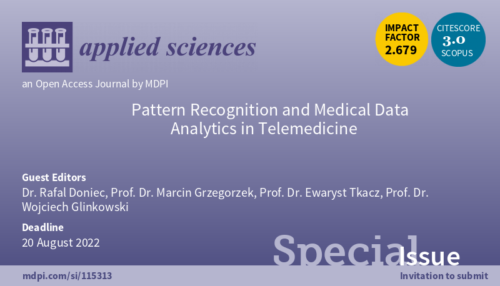
W imieniu Grona Redaktorów specjalnego wydania czasopisma Applied Sciences (MDPI) oraz Zarządu PTTMeZ  zapraszamy do składania artykułów do redakcji. Czasopismo o wartości Impact Factor 2,679 oraz 100 punktów Ministerialnych. Czasopismo jest recenzowane a informacje o sposobie przygotowania artykułu do submisji do czasopisma można znaleźć na stronie internetowej https://www.mdpi.com/journal/applsci/special_issues/pr_mda_telemedicine. Poniżej znajduje się broszura informacyjna. Serdecznie zapraszamy!

Regulacje prawne i wytyczne dobrych praktyk dla świadczenia telekonsultacji na przykładzie Polski

W okresie pandemii wdrażanie rozwiązań telemedycznych istotnie przyspieszyło. W skali globalnej wystąpił swoisty stan „zakłócenia” lub „rozregulowania” (disruption) prawnego i organizacyjnego. Telekonsultacje i badania pacjentów na odległość weszły do codziennej praktyki lekarskiej i stały się doświadczeniem znanym pacjentom. Dostosowanie przepisów prawa, rozporządzeń, wytycznych i regulaminów placówek ochrony zdrowia stało się pilną koniecznością w wielu krajach. W niedawno opublikowanym artykule, którego współautorami są członkowie PTTMeZ, dokonano przeglądu i analizy stanu regulacji prawnych i wytycznych dobrych praktyk odnośnie teleporad w Polsce, oraz porównano ogólne ramy prawne w Unii Europejskiej i stan prawny w krajach Europy wiodących w rozwoju telemedycyny.

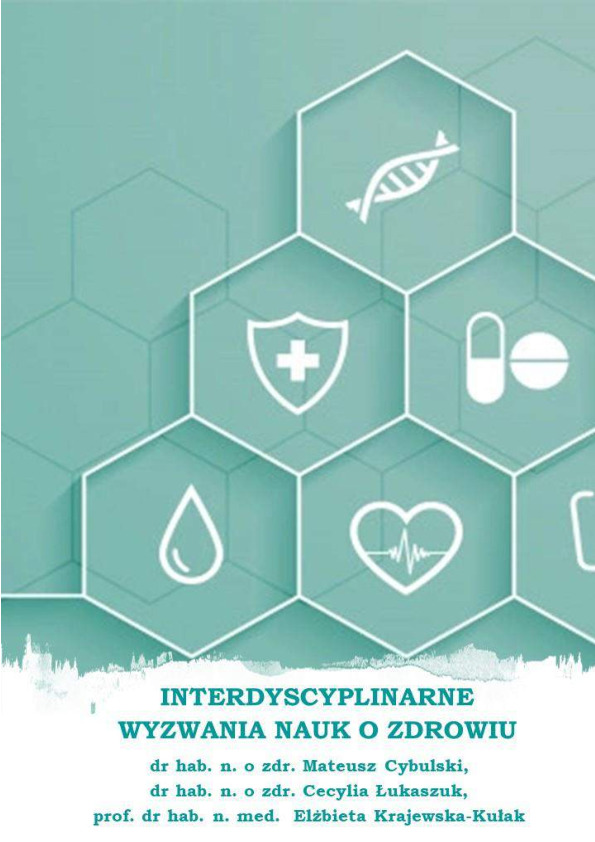
Jacennik, B., Wysocki, P., Langrand, C., Jankowska, A.K., Sadowska, M., Glinkowski, W. (2021) Regulacje prawne i wytyczne dobrych praktyk dla świadczenia telekonsultacji – na przykładzie Polski W: M. Cybulski, C. Łukaszuk, E. Krajewska-Kułak (red.), Interdyscyplinarne wyzwania nauk o zdrowiu (s. 27-56). Uniwersytet Medyczny w Białymstoku.

Pełna treść manuskryptu dostępna jest pod adresem: https://www.umb.edu.pl/photo/pliki/WNoZ_jednostki/wnoz-z-zintegrowanej-opieki-medycznej/monografie/interdyscyplinarne_wyzwania_nauk_o_zdrowiu-skompresowany.pdf