Serdecznie zapraszamy do udziału w Telemedicine and e-Health: International Conference 2026, która organizowana jest przez Polskie Towarzystwo Telemedycyny i e-Zdrowia od 2004 roku nieprzerwanie również podczas pandemii COVID-19. W tym roku konferencja odbędzie się w dniu 2026-10-01. Możliwy jest udział hybrydowy (online/osobiście) podczas Targów Rehabilitacja (PTAK Warsaw Expo, Hala E). Termin nadsyłania prac: 2026-08-31. Rejestracja jest wymagana. Zo dobaczenia!
The upcoming Telemedicine and e-Health: International Conference 2026 is organized by the Polish Telemedicine and eHealth Society annually since 2004 and have continued without interruption during COVID-19 pandemic. This year conference takes place on 1st October 2026. Hybrid attendance is possible (online/in-person) during Rehabilitation Trade Fair (PTAK Warsaw Expo, Hall E). Registration is required. Abstract submission deadline: 2026-08-31. See you there!
This time we share our latest technical publication from the world of embedded systems and electronics, authored by Tomasz Cedro (1,2,5,6), Gregory Nutt (1), Lup Yuen Lee (1), Grzegorz Południewski (2,6), Szymon Wilk (2,4), and Wojciech Glinkowski (2,3), from the (1) Apache NuttX RTOS; (2) Polish Telemedicine and e-Health Society; (3) Warsaw Medical University, Poland; (4) Poznan University of Technology, Poland; (5) CeDeROM, Poland, (6) IQCREDO, Poland.
Paper was published in the International Journal of Electronics and Telecommunications, Vol. 72 No. 3 (2026) and is available online in open-access at IJET and NuttX websites.
In attach the fast cal of the 23 conference on eGovernmenteHealth on next July 10 2026 (national session 50 years after the dioxine pollicino disater in north Italy) and July 11 2026 (One Digital Health international session). Hoping in your scientific interest and participation receive my Best Regards,
It is our great pleasure to announce another interesting scientific article „Digital Twins in Orthopedics and Trauma: Concepts, Emerging Evidence, and Barriers to Clinical Translation” authored by Wojciech Michał Glinkowski (1,2), Tomasz Gieroba (3), Andrzej Śliwczyński (3), from (1) Center of Excellence “TeleOrto” for Telediagnostics and Treatment of Disorders and Injuries of the Locomotor System, Department of Medical Informatics and Telemedicine, Medical University of Warsaw, Poland; (2) Polish Telemedicine and eHealth Society, Warszawa, Poland; (3) Institute of Psychology and Human Sciences, WSEI University, Lublin, Poland.
Paper was published in Journal of Clinical Medicine 2026, 15(11), 4127 (IF2.9, CS5.2) and is available online in open-access at https://doi.org/10.3390/jcm15114127.
We are happy to share invitation to the 12th Annual PROMIS International Conference [1], „Shaping Better Health Through Patient-Reported Insights: Utilizing PROMIS to Advance Care and Improve Health Systems” that takes place on 22-23 October 2026 in Prague, Czechia.
Program Highlights
Plenary 1: The Global Revolution: Transforming Health Systems Through PROMs.
Plenary 2: Operationalizing PROMIS for Meaningful Action: Advancing Systems, Clinics, and the Patient Experience.
Plenary 3: Real-World PROMs Action: Integrating Crosswalks, Interpretation, and AI for Better Care.
International Session: PROMIS Around the World – What’s New.
Using patient-reported outcome measures (PROMs) for patient-centered value-based health care, from clinical trials and routine care to health system evaluation, performance measurement, and accountability.
Using PROMIS measures to address practical measurement problems in health-related research and clinical practice.
Using PROMIS measures to improve community, opportunity, and engagement across all patients in health-related research and clinical practice.
Using PROMIS measures to inform individual and population-based patient care, clinical quality improvements, enhance value in health systems, and to meet regulatory/payor requirements.
Applying implementation strategies to move PROMIS from research settings into clinical practice or health-system wide integration.
Benefitting from psychometrically developed measures, like PROMIS to inform individual and group level change scores and support rigorous outcome assessment.
Determining how PROMIS can be used for screening, symptom management and monitoring in rare and chronic diseases.
Program Chairs
David Bernstein, MD, PhD, MBA, MEI (USA).
Gemma Vilagut, PhD, MSc (Spain)
Early Registration is Open
(The PHO Conference follows the ISOQOL Conference)
With great pleasure and joy we are sharing our latest scientific publication titled „AI-Assisted Training for Teleconsultation Competencies in Undergraduate Medical Education: A Narrative Review„, co-authored by Wojciech Michał GLINKOWSKI (1,2), Barbara JACENNIK (2,3), Aldona Katarzyna JANKOWSKA (4,5), Tomasz CEDRO (2), Szymon WILK (2,6), Rafał DONIEC (2,7), from (1) Center of Excellence “TeleOrto” for Telediagnostics and Treatment of Disorders and Injuries of the Locomotor System, Department of Medical Informatics and Telemedicine, Medical University of Warsaw, Warsaw, Poland; (2) The Polish Telemedicine and eHealth Society, Warsaw, Poland; (3) Faculty of Social Sciences, Prince Mieszko I Poznań Medical University of Applied Sciences, Poznań, Poland; (4) Polish Academy of Sciences Scientific Station in Paris, Paris, France; (6) Faculty of Computing and Telecommunications, Poznan University of Technology, Poznan, Poland; (7) Faculty of Medical Sciences in Zabrze, Medical University of Silesia, Katowice, Poland. Paper was published in Applied Sciences 2026, 16(10), 4858 journal (IF2.5, CS5.5) and is available online in open-access at https://doi.org/10.3390/app16104858.
The Medical Research Archives [1] (ISSN: 2375-1924), the official journal of the European Society of Medicine [1], is accepting submissions for a theme issue on Telemedicine in Orthopedics and Sports Medicine. Original research articles, review articles, and case studies are welcome. Submission deadline: June 20, 2026. For more information, contact alex.clark[at]esmedhealth.org.
We are pleased to share article titled „AI-Assisted Fracture Detection in Orthopedic and Trauma Imaging: Where It Works, Where It Fails, and Principles for Safe Clinical Deployment”, published in the Diagnostics 2026, 16(10), 1420, authored by Wojciech Michał Glinkowski (Center of Excellence “TeleOrto” for Telediagnostics and Treatment of Disorders and Injuries of the Locomotor System, Department of Medical Informatics and Telemedicine, Medical University of Warsaw; President of the Polish Telemedicine Society), Paweł Kaminski (Clinic of Locomotor Disorders, Andrzej Frycz Modrzewski University, Kraków, and Malopolan Orthopedic and Rehabilitation Hospital, Kraków), and Rafał Obuchowicz (Department of Diagnostic Imaging, Jagiellonian University Medical College, Kraków). Article is available online at https://doi.org/10.3390/diagnostics16101420.
Serdecznie zapraszamy do uczestnictwa w Międzynarodowym Sympozjum Warsztatowym Telemedycyna i eZdrowie 2026. Sympozjum jest dodatkowym wydarzeniem obok Konferencji Międzynarodowej, której organizację nasze Stowarzyszenie rozpoczęło już w 2004 roku nieprzerwanie również podczas pandemii COVID-19. W tym roku współorganizatorami są Wydział Medyczny Collegium Medicum Uniwersytetu Kardynała Stefana Wyszyńskiego w Warszawie oraz Zakład Informatyki Medycznej i Telemedycyny Warszawskiego Uniwersytetu Medycznego. Warsztaty mają charakter hybrydowy z możliwością uczestnictwa osobistego i online. Konieczna jest rejestracja online. Link do streamingu otrzymają osoby zarejestrowane. Udział jest bezpłatny. Konferencja odbędzie się w Warszawie w dniu 20.05.2026. Do zobaczenia!
The upcoming Telemedicine and e-Health: International Workshop Symposium 2026, in addition to the International Conference organized by the Polish Telemedicine and eHealth Society annually since 2004 and have continued without interruption also during COVID-19 pandemic. This year conference is co-organized together with Collegium Medicum of Cardinal Stefan Wyszyński University, Warsaw and Department of Medical Informatics and Telemedicine of Warsaw Medical University. Workshops will be held hybrid, both in person and online presence is possible. Registration is required. Link to the conference will be provided to registered users. Attendance is free of charge. Conference takes place in Warsaw on 20.05.2026. See you there!
Serdecznie zapraszamy do udziału w konferencji TELEREHABILITACJA – TRENDY, WYZWANIA, NADZIEJE [1], poświęconej telerehabilitacji w neurologii, kardiologii, geriatrii i ortopedii. Wydarzenie odbędzie się w dniu 23.04.2026 w Warszawie, udział bezpłatny, możliwość uczestnictwa osobiście oraz online.
Abstract National telehealth and eHealth societies are essential actors in digital transformation, yet their impact remains uneven, fragmented, and insufficiently coordinated. Drawing on trends across ten countries, including Finland, Germany, India, the Ivory Coast, Japan, Jordan, Morocco, Nigeria, Poland, and Slovenia, this opinion argues that these societies hold crucial but underused positions in global digital health governance. They contribute to evidence generation, regulatory discourse, workforce development, and the adaptation of digital solutions to local contexts. However, without structured mechanisms for collaboration, such strengths remain isolated and global disparities deepen. We propose that the International Society for Telemedicine and eHealth (ISfTeH) can evolve from a networking platform into an orchestrator that consolidates knowledge, reduces duplication, and supports equitable digital transformation. The future of telehealth depends not only on technological innovation but also on institutions’ capacity to share expertise, co-develop strategies, and build collective capabilities.
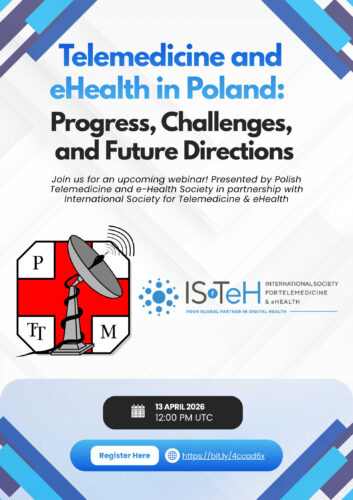
The International Society for Telemedicine and eHealth (ISfTeH), in collaboration with the Polish Telemedicine and e-Health Society, invites participants to an upcoming webinar (2026-04-13 12:00UTC online) devoted to recent developments in telemedicine, eHealth, and the broader digital transformation of healthcare in Poland.
The event forms part of the expanding ISfTeH webinar series organized by its national member societies. For readers of the Finnish Journal of eHealth and eWelfare, it may be seen as a continuation of the international exchange initiated by the January 2026 webinar, Effectiveness of Digital Health Care Services – Case Studies from Finland. That session brought together distinguished speakers from Finland, including leaders in academia and healthcare, who presented practical insights and real-world examples on the effectiveness of digital health services. Our upcoming Polish webinar offers a national perspective, focusing on Poland’s recent experience in digital health development.
The webinar will present Poland as a case study of dynamic change in digitally enabled healthcare. Particular attention will be given to the growth of teleconsultations, the implementation of e-prescriptions, the development of national eHealth infrastructure, and the emergence of AI-supported solutions in clinical practice. The discussion will address key challenges, including interoperability, quality evaluation, regulation, physician education, and the evolving role of Clinical Informatics and Digital Medicine -a specialty for physicians.
The draft programme includes contributions from presenters representing academia, professional organizations, public institutions, and industry. Together, these contributions will offer a broad overview of current progress in Polish telemedicine and eHealth, while also reflecting on unresolved systemic barriers, examples of practical innovation, and possible future directions.
More broadly, the webinar reflects ISfTeH’s continuing effort to strengthen international dialogue among national member societies and to share country-based experiences that may inform digital health policy, research, and practice across Europe and beyond.
Date: 13 April 2026 (Monday) Time: 12:00 UTC / 14:00 CEST Format: Online
Further details and registration information will be shared through ISfTeH communication channels.
Finnish eHealth Conference 2026 – Effective Digital Solutions in Health Care and Social Welfare Services takes place on October 1–2, 2026, at Helsinki, Finland.
The Finnish Society of Telemedicine and eHealth invites researchers, developers, professionals, and decision-makers across health care, social welfare, rehabilitation, and technology sectors to join the eHealth Conference 2026. This year’s theme, “Effective Digital Solutions in Health Care and Social Welfare Services”, highlights impactful innovations and evidence-based digital practices across the field.
The annual conference will take place at University of Helsinki and is organized in collaboration with the Finnish Society for Effectiveness in Social and Health.
Abstract submissions are open from March 2 to May 3, 2026. Detailed submission guidelines are available at [1]. The full conference programme has been published, and registration is now open [2].
Early Bird (until June 30, 2026):
• Members of the Impact Society and the Finnish Society of Telemedicine and eHealth: €420 (+ VAT 25.5%)
• Non-members: €450 (+ VAT 25.5%) Standard Fee (from July 1, 2026):
• All participants: €525 (+ VAT 25.5%)
(Member pricing no longer applies after June 30.)
Join us in Helsinki to explore cutting‑edge digital health innovations and foster collaboration across sectors shaping the future of health and social welfare services.
Urząd Patentowy Rzeczypospolitej Polskiej ma przyjemność zaprosić Państwa na webinarium pt. „Gdy ochrona wynalazku sięga poza kraj – jak chronić rozwiązania techniczne w procedurze regionalnej i międzynarodowej”, które odbędzie się w środę, 1 kwietnia 2026 r. o godz. 10:00. Wydarzenie będzie trwało ok. 1,5 godziny.
Podczas spotkania poznasz m.in.
czym jest patent europejski i jakie daje możliwości,
jak przebiega walidacja patentu europejskiego w Polsce,
jak wygląda krok po kroku zgłoszenie międzynarodowe w trybie PCT,
co warto wiedzieć o fazie krajowej zgłoszenia w Polsce,
opłaty i koszty związane z ochroną wynalazków w omawianych systemach.
Webinarium poprowadzi Pan Łukasz Jankowski – ekspert w Departamencie Zgłoszeń Urzędu Patentowego Rzeczypospolitej Polskiej. W dniu wydarzenialink do połączenia dostępny będzie tutaj.
Serdecznie zapraszamy! Jeśli znają Państwo osoby, które może zaciekawić temat naszego wydarzenia to zachęcamy do przekazania naszego zaproszenia dalej! Poniżej przesyłamy linki do postów promujących wydarzenie w naszych mediach społecznościowych. Będziemy wdzięczni za ich udostępnienie.
Join Dr. Poullos on 4/25.Registration is now open [1]. Secure your spot today. We look forward to seeing you there and thank you for generously supporting our work.
We would like to cordially invite you to participate in the 7th World Scientific Congress “Quality of Life in an Interdisciplinary Approach”, which will be held on 21–23 October 2026 in Kochcice, Poland. The Congress will bring together researchers and practitioners from various scientific disciplines to exchange knowledge and discuss current issues related to quality of life from an interdisciplinary perspective. Please find detailed information about the Congress in the attached announcement.

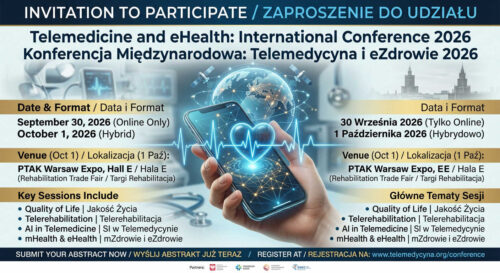 Serdecznie zapraszamy do udziału w Telemedicine and e-Health: International Conference 2026, która organizowana jest przez Polskie Towarzystwo Telemedycyny i e-Zdrowia od 2004 roku nieprzerwanie również podczas pandemii COVID-19. W tym roku konferencja odbędzie się w dniu 2026-10-01. Możliwy jest udział hybrydowy (online/osobiście) podczas Targów Rehabilitacja (PTAK Warsaw Expo, Hala E). Termin nadsyłania prac: 2026-08-31. Rejestracja jest wymagana. Zo dobaczenia!